Why are some products cheaper? Cheap vs Value: How to Compare Hygiene Products Properly
9 June 2026
When you're buying hygiene and cleaning supplies, the cheapest product isn't always the best value. Two products can look almost identical online but vary significantly in size, quality, durability and performance. A lower purchase price may simply reflect a reduced specification, meaning you could end up using more product, replacing it more often or compromising on performance.
In this guide, we'll explain what specifications matter most when comparing paper products, disposable gloves, cleaning chemicals and refuse sacks, helping you make informed purchasing decisions.
This Article Covers
- Why paper specifications matter
- How to compare couch rolls properly
- Why V-Fold and Z-Fold hand towels often offer better value
- What to look for when comparing disposable gloves
- How cleaning chemical dilution affects cost
- What makes a quality refuse sack
- A simple checklist for comparing hygiene products
Why Do Some Paper Products Cost Less?
Paper manufacturers can alter specifications to achieve a lower price point.
This may include:
- Shorter roll lengths
- Narrower roll widths
- Lower paper grammage (weight)
- Fewer rolls per case
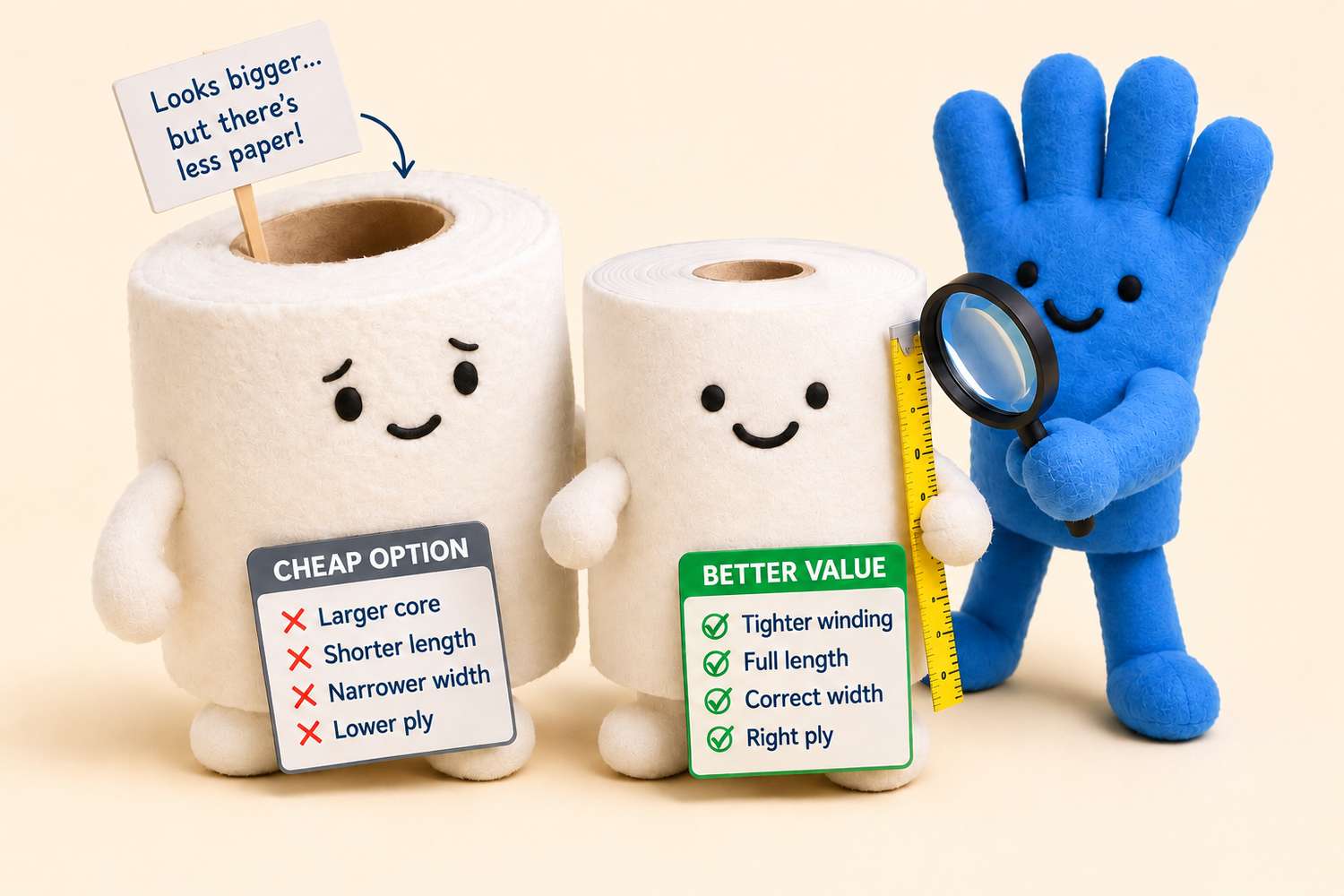
- Larger cores or looser winding that make rolls appear bigger than they actually are
These changes can significantly reduce manufacturing costs while making products appear similar at first glance.
When comparing paper products, always check the full specification rather than the price alone.
Have Paper Roll Specifications Changed?
Yes - noticeably. Many paper products have gradually reduced in size over recent years.
For example:
Centrefeed rolls that were once commonly 25cm wide are now often 18–20cm wide
Many traditional 2 ply rolls that offered around 180m per roll are now frequently supplied in lengths of 110–140m
Some rolls use larger cores or looser winding to maintain a similar diameter despite containing less paper
A roll may look larger, but the usable paper inside can be significantly lower grade.
Tip: Roll diameter alone is not a reliable measure of value. Always compare roll length, width and ply.
How to Compare Couch Rolls Properly
Couch rolls are one of the easiest products to compare incorrectly.
The biggest differences are often hidden within the specification:
- Roll length
- Roll width
- Number of rolls per case
- Ply count
- Paper quality
For example, one supplier may offer a box of six rolls while another offers twelve. Some rolls may be narrower, shorter, or made from lower-grade paper.
Two couch rolls can appear almost identical online yet provide very different value per metre.
Before comparing prices, always calculate the cost per roll or cost per metre.
Why V-Fold and Z-Fold Hand Towels Often Offer Better Value
C-Fold hand towels remain common in many washrooms, but they are not always the most economical option. Because C-Fold towels are stacked rather than interlocked, users often pull out multiple towels at once. This can increase consumption and waste.
V-Fold and Z-Fold hand towels are designed to:
- Dispense one towel at a time
- Automatically present the next sheet
- Reduce wastage
- Improve hygiene by reducing contact with the dispenser
They are available in recycled single-ply options as well as premium 2-ply and 3-ply white grades, making them suitable for a wide range of environments.
In many workplaces, the reduction in towel usage can outweigh any difference in purchase price by swapping from C-Fold to Z or V-Fold.
How to Compare Disposable Gloves
Disposable gloves are often viewed as a commodity product, but quality can vary significantly.
Lower-cost gloves may:
- Be manufactured from thinner material
- Offer reduced puncture resistance
- Tear more easily during use
- Provide inconsistent sizing and fit
- Lack the certifications required for specific tasks
A glove that tears halfway through a job often needs replacing immediately. Over time, repeated glove changes can increase usage and reduce productivity.
A well-made glove can provide:
- Better comfort
- Improved durability
- Greater user confidence
- Consistent protection
When comparing gloves, always check the intended application, certification, thickness and material quality, not simply the price per box.

How to Compare Cleaning Chemicals
Cleaning chemicals can be particularly difficult to compare because performance is not always obvious from the label.
Manufacturers may reduce costs by:
- Lowering the concentration of active ingredients
- Using lower-cost raw materials
- Recommending higher usage rates
This means a cheaper product may actually cost more to use over time.
For example, a concentrated cleaner diluted at 1:100 can produce hundreds of litres of ready-to-use solution. A lower-cost alternative may require significantly more product per clean, increasing both product consumption and labour costs.
Other consequences can include:
- Longer cleaning times
- Poorer cleaning results
- Streaking or residue
- More frequent reapplication
When comparing chemicals, consider cost per use rather than cost per bottle.
What Makes a Good Quality Refuse Sack?
Refuse sacks are another product where specification matters.
The cheapest sack is rarely the most economical if it fails during use.
Important factors to consider include:
- Micron thickness
- Tear resistance
- Puncture resistance
- Capacity accuracy
- Manufacturing consistency
Poor-quality sacks can split when lifted or dragged, resulting in additional cleaning, wasted labour and product loss. Commercial-grade sacks are designed to withstand the demands of daily use and often provide better value despite a slightly higher purchase price.

How we keep quality high without inflating prices
At Hygiene Depot, our own-brand PRO products are specified directly with manufacturers to deliver consistent performance and transparent specifications.
We focus on:
- Accurate roll lengths and dimensions
- Consistent paper quality
- Reliable glove performance
- Commercial-grade refuse sacks
- Effective cleaning formulations
By working directly with manufacturers, we're able to offer products that deliver dependable performance without the premium often associated with major brands.
A Simple Product Comparison Checklist
Before choosing the cheapest option, check:
✔ Roll length
✔ Roll width
✔ Ply count
✔ Paper grammage
✔ Rolls per case
✔ Glove certification
✔ Glove thickness and durability
✔ Chemical dilution ratio
✔ Refuse sack micron thickness
✔ Product reviews and performance feedback
If a hygiene product appears significantly cheaper than comparable alternatives, there is often a reason.
The difference may be:
- Shorter rolls
- Lower paper weight
- Fewer products per case
- Thinner gloves
- Weaker refuse sacks
- Less concentrated chemicals
Price is important, but it should never be the only factor in your decision. True value comes from products that perform consistently, last longer, reduce waste and save time in day-to-day use.
If you'd like help comparing products or specifications, our team is always happy to help. Contact us on 0117 946 1960 or contact us.

How can I prepare for cold and flu season? 5 October 2026

What do you really need for an effective Spring Clean? 8 June 2026

How can I get the most out of my microfibre cloths? 8 June 2026

Why is Hygiene Depot is expanding into Pet Care? 8 June 2026

Why are Orange Nitrile Gloves so popular in heavy-duty industries? 8 June 2026
Why are Nitrile Glove prices increasing in 2026? 2 June 2026
What is Airlaid? (And why it feels like linen) 17 March 2026
Are Biodegradable Nitrile Gloves genuinely Biodegradable? 26 February 2026

How sustainable are disposable paper products? 11 November 2025

Why do I have to pay for delivery? 5 November 2025