Are Biodegradable Nitrile Gloves genuinely Biodegradable?
26 February 2026
Are Biodegradable Nitrile Gloves genuinely biodegradable?
With so many sustainability claims in the PPE market, it’s
reasonable to ask questions.
Disposable gloves and environmental responsibility don’t
always sound like natural partners. Therefore, when you see the phrase biodegradable
nitrile gloves, scepticism is healthy.
Do they really biodegrade?
Or is it just clever marketing?
Let’s break it down properly.
Why Standard Nitrile Gloves Don’t Break Down Easily
Traditional nitrile gloves are made from synthetic rubber
(nitrile butadiene rubber).
That’s what makes them:
- Highly
durable
- Chemically
resistant
- Excellent
barrier protection
But durability comes at a cost.
Conventional nitrile gloves can remain in landfill for
decades because microbes struggle to digest synthetic rubber. They may fragment
slowly over time, but they do not meaningfully biodegrade.
That’s where biodegradable nitrile technology differs.
What ‘Biodegradable’ Actually Means
Biodegradable nitrile gloves are not compostable gloves.
They are also not oxo-degradable plastics that simply break into smaller
fragments.
Instead, they contain an organic additive blended into the
nitrile compound during manufacturing. Once disposed of in an active landfill
environment (where oxygen is limited and microbial activity is high), this
additive attracts naturally occurring bacteria.
Those microbes break the material down and convert it into:
- Biogas
- Biomass
- Water
That is true microbial biodegradation. Not just surface
breakdown or fragmentation.

The Standard Behind the Claim: ASTM D5511
Genuine biodegradable nitrile gloves are tested to ASTM
D5511, a recognised laboratory standard that simulates biologically active
landfill conditions.
In simple terms, this test measures how much of the material
converts into biogas under anaerobic (oxygen-free) conditions over time.
Under ASTM D5511 simulation, some biodegradable nitrile
gloves have demonstrated up to 90% biodegradation in approximately 490 days.
For comparison, standard nitrile gloves show little to no
biodegradation under the same conditions.
This is the difference between a marketing phrase and a
measurable environmental claim.
What Biodegradable Nitrile Gloves Are Not
Clarity matters in sustainability.
Biodegradable nitrile gloves:
- Are
not designed for home composting
- Do
not degrade on the shelf
- Do
not weaken during use
- Do
not disappear in open air
The biodegradation process only begins once the glove enters
a biologically active landfill environment.
This is important because it means performance is not
compromised.
Do Biodegradable Gloves Fall Apart During Use?
No.
High-quality biodegradable nitrile gloves are engineered to
deliver the same performance as standard nitrile.
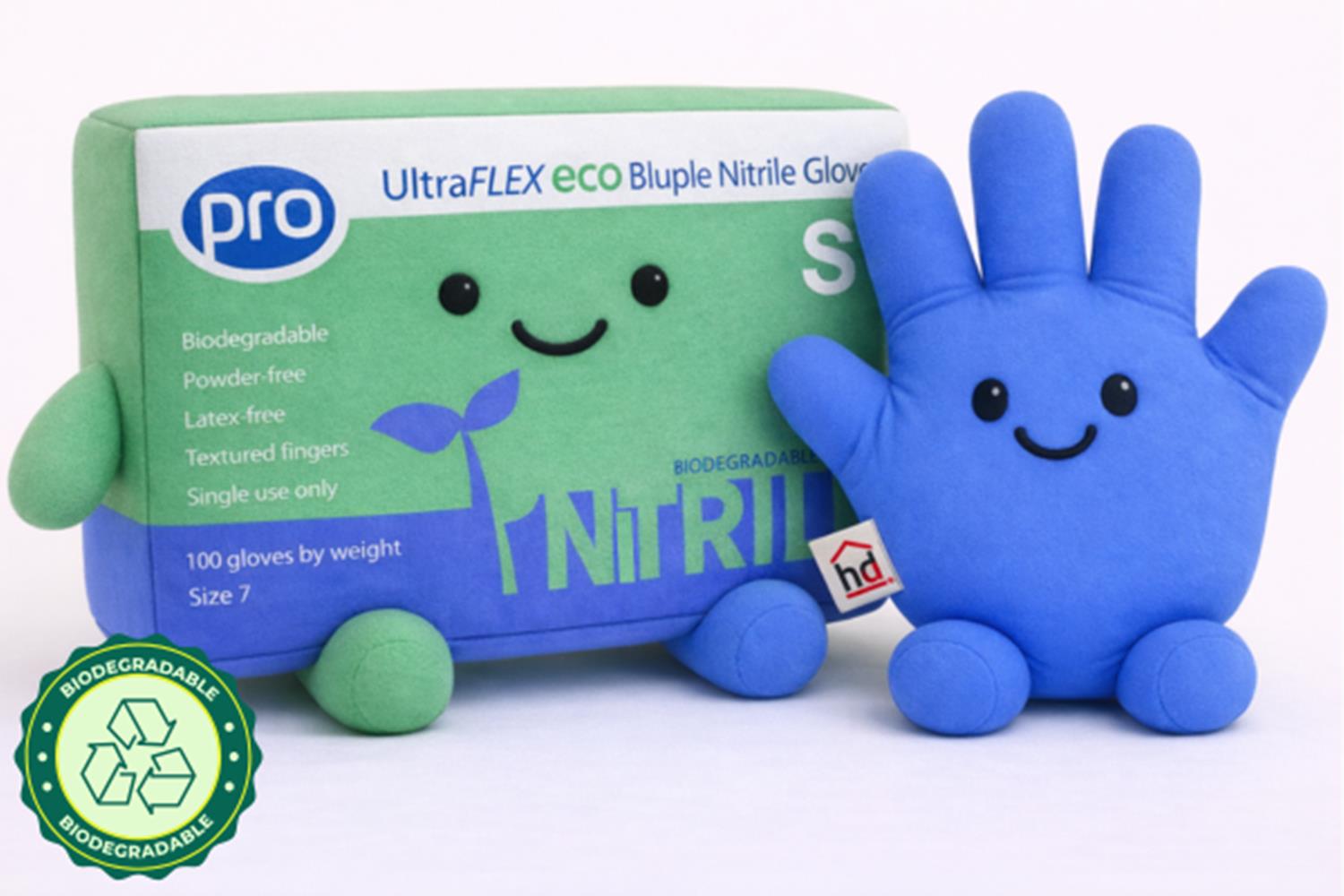
For example, PRO UltraFLEX Eco Bluple Nitrile Gloves are:
- Tested
to EN374 for chemical resistance
- Tested
to EN455 for medical standards
- Powder-free
and latex-free
- Textured
for grip
- Manufactured
at a robust 3 mil thickness
The biodegradable additive does not affect shelf life,
elasticity, tensile strength or barrier protection.
You get the same protection. The difference happens after
disposal.
How Long Do They Take to Break Down?
Under ASTM D5511 landfill simulation, biodegradable nitrile
gloves can achieve significant degradation within 1–5 years.
Real-world landfill conditions vary depending on
temperature, moisture and microbial activity. But compared to conventional
nitrile gloves, which can persist for decades - the reduction in long-term
landfill impact is considerable.
For high-volume glove users, that difference adds up.
Why Businesses Are Switching to Biodegradable Nitrile
Gloves
Many different industries including; Healthcare providers,
cleaning companies, food production facilities, beauty professionals and
agricultural businesses all rely heavily on disposable PPE.
Switching to biodegradable nitrile gloves allows
organisations to:
- Maintain
compliance and protection standards
- Reduce
long-term landfill persistence
- Support
ESG and sustainability targets
- Avoid
latex allergy risks
Without sacrificing durability or safety.
How to Identify Genuine Biodegradable Gloves
If you’re evaluating suppliers, look for:
- Clear
reference to ASTM D5511 testing
- Published
biodegradation percentages
- Explanation
of landfill-specific conditions
- Transparent
limitations (not vague “eco-friendly” claims)
A supplier should be able to explain how the biodegradation
process works, not just state that it happens.
So, Are They Genuinely Biodegradable?
Yes, when tested and verified under recognised landfill
standards.
Biodegradable nitrile gloves do not fall apart during use. They
do not compromise protection. They do not rely on vague environmental claims.
They are designed to perform like traditional nitrile gloves
while reducing long-term persistence in landfill conditions.
The difference isn’t how they behave on your hands. It’s
what happens after disposal.
Looking for Certified Biodegradable Nitrile Gloves?
If you need landfill-tested biodegradable nitrile gloves for
healthcare, cleaning, food handling, industrial use or want to make the switch
to an eco-choice, explore our PRO UltraFLEX biodegradable nitrile gloves designed for professional environments. The more customers switch to
biodegradable nitrile gloves, the more we can create change in the PPE market.
Making sustainable choices in PPE doesn’t require compromise, just better technology.

How can I prepare for cold and flu season? 5 October 2026

What do you really need for an effective Spring Clean? 8 June 2026

How can I get the most out of my microfibre cloths? 8 June 2026

Why is Hygiene Depot is expanding into Pet Care? 8 June 2026

Why are Orange Nitrile Gloves so popular in heavy-duty industries? 8 June 2026
Why are Nitrile Glove prices increasing in 2026? 2 June 2026
What is Airlaid? (And why it feels like linen) 17 March 2026

How sustainable are disposable paper products? 11 November 2025

Why do I have to pay for delivery? 5 November 2025
Why are some disposable gloves more expensive? 24 September 2025